Commercial MEES Update – Government Sets Out Proposed Changes

The Government has announced a significant revision to its proposed changes to Minimum Energy Efficiency Standards (MEES) for commercial property, softening earlier plans that would have imposed stricter EPC requirements across much of the rented commercial sector.
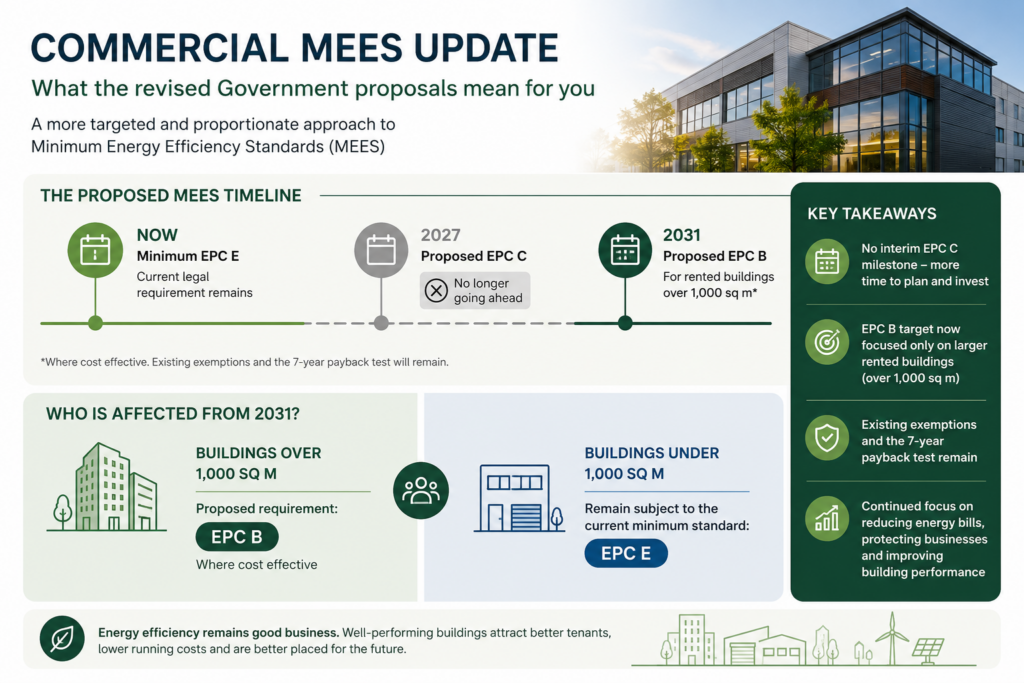
Previous proposals suggested all rented non-domestic properties would need to achieve EPC C by 2027 and EPC B by 2030. However, the latest update adopts a more targeted approach.
Under the revised proposals, only rented commercial buildings exceeding 1,000 sq. m. (10,764 sq. ft.) in England and Wales would be required to achieve EPC B by 2031, where cost effective. Buildings below this threshold would remain subject to the current minimum standard of EPC E.
The Government has also confirmed that the previously proposed interim EPC C milestone will not be introduced, providing landlords and occupiers with greater flexibility to plan energy efficiency improvements.
The Government’s latest position is set out in the Written Ministerial Statement dated 18 June 2026, which confirms a more targeted approach to strengthening Minimum Energy Efficiency Standards (MEES) in the non-domestic private rented sector.
While this provides welcome clarity on the overall direction of policy, it remains an interim statement and further detail is expected once the full consultation response and draft legislation are published.
In particular, some areas of practical application are still to be confirmed – including how the requirements will apply to multi-let buildings and the treatment of larger properties that are subdivided into smaller demises. As a result, landlords and investors should treat the current position as a policy framework rather than a fully defined regulatory regime.
What does this mean in practice?
For many landlords, particularly those owning smaller offices, industrial units and retail premises, the immediate regulatory pressure has eased. This will come as welcome news to owners of older secondary stock, where achieving higher EPC ratings can involve significant capital expenditure.
However, this should not be viewed as the end of the story.
Energy efficiency remains an increasingly important factor in commercial property performance. Occupiers are placing greater emphasis on sustainability, operational costs and ESG credentials, while lenders and investors are continuing to scrutinise asset quality and future obsolescence risk. In simple terms, even where legislation may not force immediate upgrades, the market increasingly will.
For owners of larger commercial assets, particularly offices and multi-let buildings, now remains a sensible time to assess EPC ratings, review improvement options and understand likely upgrade costs. Early planning can help avoid rushed and expensive compliance works later.
While the Government’s revised approach provides breathing space, the long-term direction remains clear – energy-efficient buildings will continue to be better placed to attract occupiers, protect value and remain competitive in the market.
If you would like more information, please contact Hamish Stone MRICS on 01473 232701.